Red light therapy and sunlight: How specific wavelengths of light optimize sleep, hormones, immunity, pain and vision

This is science-based advice from Dr. Andrew Huberman. Light is not just what we see. Different wavelengths act as biological signals that change hormones, brain states, immune readiness and cellular metabolism. This article explains how to use sunlight, UVB, blue light and red light therapy in practical, safe ways backed by peer-reviewed research.
Table of Contents
- How light works: the essentials
- Melatonin, seasonality and simple timing rules
- UVB skin exposure: hormones, immune readiness and pain tolerance
- Lights to avoid at night
- Red light therapy: mechanism and practical protocols
- Red light at night and for shift work
- Flicker phototherapy and brain oscillations
- Practical safety checklist
- Quick reference protocols
- What is red light therapy and how does it work?
- Can red light therapy improve vision?
- Is red light therapy safe at night for shift workers?
- How much sun should I get for hormonal and immune benefits?
- References and further reading
How light works: the essentials
Light is electromagnetic energy that travels in waves. Wavelength determines how light behaves: short wavelengths (blue, ultraviolet) interact with surface tissues and photopigments; long wavelengths (red and near infrared) penetrate deeper into skin and cells. Different wavelengths are absorbed by different pigments and organelles, so the biological effects depend on color, intensity, timing and location of exposure.
Direct versus indirect effects
Light impacts biology two ways. Direct effects occur where photons land: eyes and skin. Indirect effects occur when those primary receivers send chemical or neural messages elsewhere in the body. For example, UVB on skin activates keratinocyte signaling that influences gonads and mood, while light on the retina alters melatonin production and entrains circadian systems.
Melatonin, seasonality and simple timing rules
Light arriving at specialized retinal cells suppresses melatonin from the pineal gland. Melatonin is a hormone that communicates day length to the body and influences sleep, bone health and reproductive timing. Practical rules:
- Get bright, early-day daylight exposure to eyes and skin when possible to set optimal circadian timing and daytime alertness.
- Avoid bright, short-wavelength (blue/UV) light between about 10 p.m. and 4 a.m. to protect melatonin-dependent recovery and mood systems.
- Dim lights for middle-of-night activity and consider long-wavelength (amber/red) bedside lighting to minimize melatonin suppression.
UVB skin exposure: hormones, immune readiness and pain tolerance
UVB light to skin activates keratinocyte pathways (including p53) that can increase sex steroids and influence mating-related physiology and behavior. Human studies using modest doses (roughly equivalent to 20–30 minutes of midday sun, 2–3 times per week for several weeks) showed increases in testosterone and estrogen and reported increases in romantic passion and arousal[1].
UVB also boosts systemic immune readiness through sympathetic signaling to the spleen and increases endogenous opioid peptides such as beta-endorphin, which raises pain tolerance[2][3]. For many people with chronic pain or winter low mood, controlled, unburning sun exposure to skin and eyes can be a helpful adjunctive tool.
Lights to avoid at night
Even low ambient light during sleep (example: rooms at 100 lux) can disrupt cardiometabolic function, increasing overnight heart rate and next-morning insulin resistance[4]. Avoid unnecessary night lighting. If illumination is required, choose dim long-wavelength sources and keep them as low as possible.
Red light therapy: mechanism and practical protocols
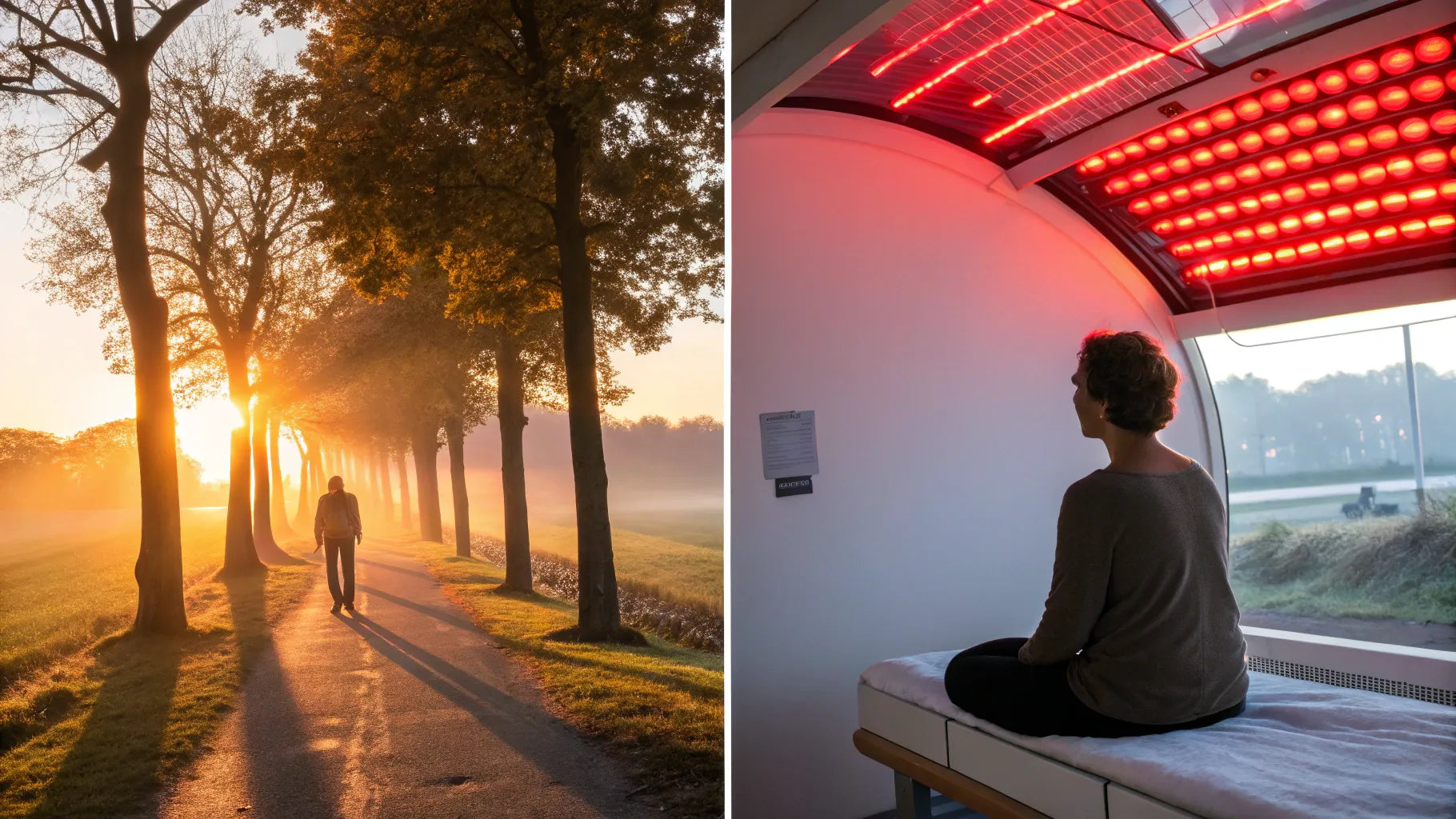
Red light therapy refers to controlled exposure to red (around 660–670 nm) and near infrared (around 790–850 nm) wavelengths. These long wavelengths penetrate skin, reach mitochondria and increase ATP production while reducing harmful reactive oxygen species. The net effect can be improved cellular energy, faster wound healing, reduced scar formation and improved skin appearance[5][6].
Clinical and human studies show meaningful results for dermatology (acne, wound healing, scar remodeling) and for neuronal tissues that are accessible to light. Key principles:
- Wavelength matters: effective bands are often near 670 nm (red) and ~790–830 nm (near infrared).
- Dosage matters: typical ocular protocols for vision studies used short daily exposures (about 1–3 minutes) at a safe viewing distance; dermatology protocols often use longer local exposure sessions over weeks[7].
- Timing matters: for neuroprotection and vision, morning exposure within a few hours of waking appears most effective in published human studies.
- Safety matters: do not stare into very bright sources; avoid devices that cause discomfort or pain to the eyes; consult eye care professionals if you have retinal disease.
Example protocol used in vision research: sit at a safe distance from a red light source emitting ~670 nm for about 2–3 minutes each morning, daily for two weeks to 12 weeks. Improvements were most notable in adults 40+ with age-related declines in visual function[7].
Red light at night and for shift work
When alertness is required at night (shift work, late study sessions), dim red light can promote wakefulness without strongly suppressing melatonin or elevating cortisol the way blue light does. Use the lowest intensity that allows task performance and avoid bright short-wavelength sources[8].
Flicker phototherapy and brain oscillations
Light can also be used as a rhythmic entrainment tool. Rapid on-off flicker at gamma frequencies (for example 40 Hz) delivered to the eyes can entrain brain gamma oscillations across multiple regions and trigger neuroprotective processes that reduce pathogenic proteins associated with cognitive decline in preclinical studies. This is an emerging area; protocols are under active investigation in clinical trials[9].
Practical safety checklist
- Never allow sun exposure that causes burning. Tailor exposure to skin type and geographic location.
- Avoid staring at any light that is painful or causes blinking/squinting. If it hurts your eyes, it is too bright.
- If you have retinal disease, macular degeneration or skin cancer risk, consult your ophthalmologist or dermatologist before increasing UVB or using concentrated devices.
- For night-time work, prefer dim red/amber lighting and minimize screen blue light when preparing for sleep.
Quick reference protocols
- Daily morning sunlight: aim for bright daylight to eyes and skin when safe; even on cloudy days outdoor light is much brighter than indoor light.
- UVB skin boost: 20–30 minutes of midday sun exposure to uncovered skin, 2–3 times per week (avoid burning); this protocol was associated with increases in sex steroids and mood in human studies[1].
- Red light therapy for vision: brief morning exposure (~2–3 minutes) to 670 nm red light at a comfortable, non-painful distance, daily for several weeks; benefits were seen in 40+ adults[7].
- Pain and mood: regular daytime UVB and bright daylight to eyes reduces pain sensitivity and supports mood; avoid UVB at night[2][3].
What is red light therapy and how does it work?
Red light therapy uses specific long wavelengths (typically ~660–670 nm and near infrared ~790–850 nm) that penetrate tissue and stimulate mitochondrial function, increasing ATP and reducing reactive oxygen species. Those cellular changes support healing, reduce inflammation and can improve skin and neuronal function[5][6][7].
Can red light therapy improve vision?
Controlled human studies reported measurable improvements in visual function in adults over 40 after short, daily 670 nm exposures over weeks. The mechanism likely involves improved photoreceptor mitochondrial function and reduced oxidative burden[7].
Is red light therapy safe at night for shift workers?
Dim red light is the preferred choice for nighttime alertness because it increases wakefulness with minimal melatonin suppression and without the cortisol elevation associated with blue light. Use the lowest effective intensity[8].
How much sun should I get for hormonal and immune benefits?
Studies that increased sex steroids used roughly the equivalent of 20–30 minutes of midday sun exposure to skin, 2–3 times per week for several weeks, with no burning. The immune and pain-tolerance benefits of UVB are tied to similar safe-exposure principles[1][2].
References and further reading
-
Skin exposure to UVB light induces a skin-brain-gonad axis and sexual behavior. Cell Reports. https://bit.ly/3MbtbeT
-
Skin Exposure to Ultraviolet B Rapidly Activates Systemic Neuroendocrine and Immunosuppressive Response. https://bit.ly/36nmojd
-
A visual circuit related to the periaqueductal gray area for the antinociceptive effects of bright light treatment. Neuron. https://bit.ly/3xutcXo
-
Light exposure during sleep impairs cardiometabolic function. https://bit.ly/3xykAPq
-
Light-emitting diodes in dermatology: A systematic review of randomized controlled trials. https://bit.ly/3viUlJW
-
Low-level laser (light) therapy (LLLT) in skin: stimulating, healing, restoring. https://bit.ly/3vwHJPQ
-
Weeklong improved colour contrast sensitivity after single 670 nm exposures associated with enhanced mitochondrial function. https://go.nature.com/3rA6IjT
-
Red Light, a novel non-pharmacological intervention to promote alertness in shift workers. https://bit.ly/3MfBbvI
-
Gamma Entrainment Binds Higher-Order Brain Regions and Offers Neuroprotection. https://bit.ly/3vqkgzB