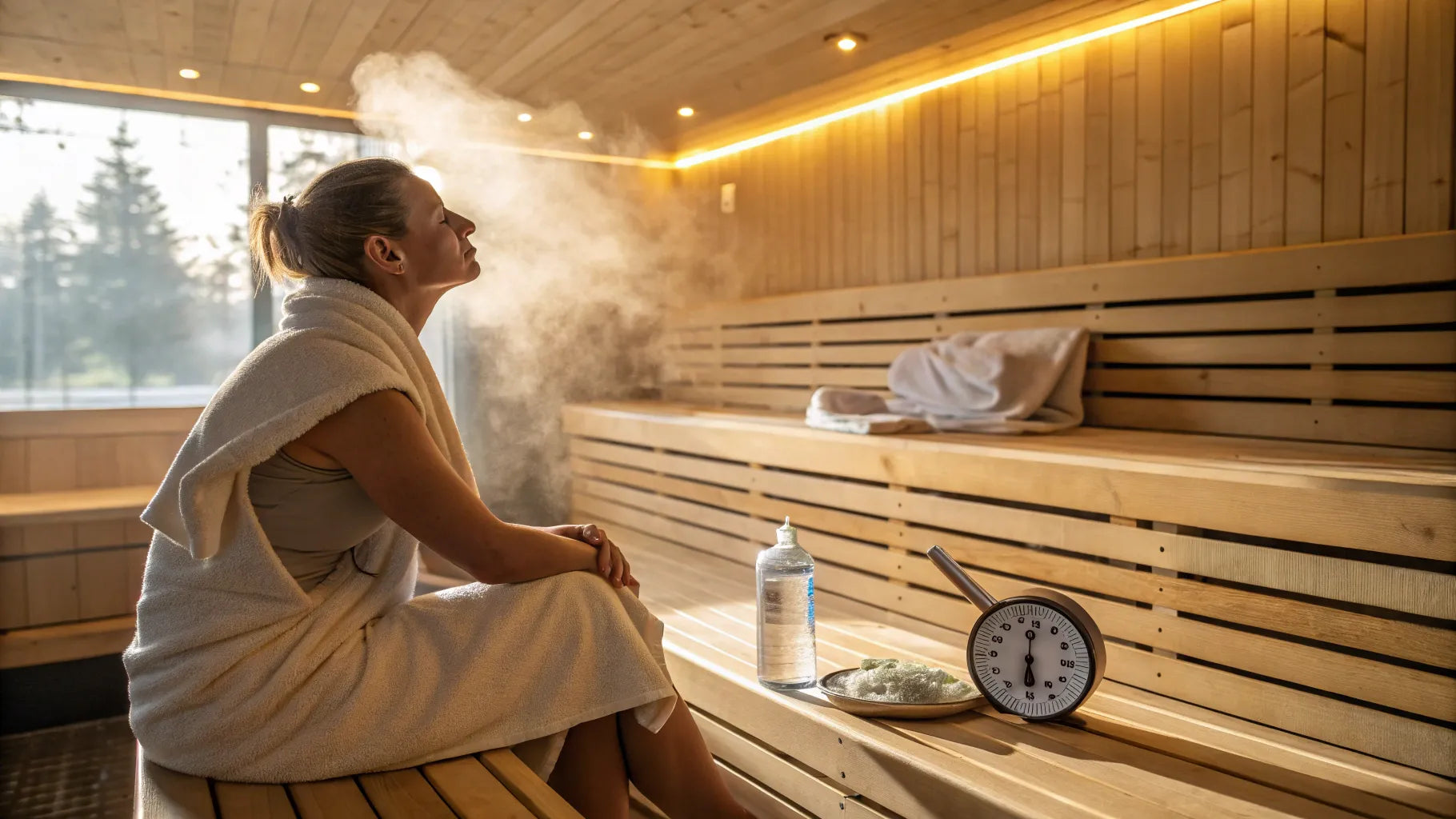
Sauna Benefits: Science-Based Protocols for Deliberate Heat Exposure

This guidance summarizes advice from Dr. Andrew Huberman on the science and practical application of heat for health. Sauna benefits are real, measurable, and depend on how you apply heat: temperature, duration, frequency, and timing all matter.
Table of Contents
- Quick reference
- How heat changes the body
- Sauna Benefits — what the science shows
- Practical protocols and matching goals
- Timing, circadian considerations, and hydration
- Rapid cooling and targeted warming
- Safety and cautions
- Local hyperthermia: a new tool for metabolic change
- FAQ
- Footnotes and studies cited
Quick reference
- Temperature range: 80–100 degrees Celsius (176–212°F) for traditional sauna protocols.
- Session length: 5–20 minutes per bout for most goals; some protocols use multiple short bouts (see growth hormone protocol).[3]
- Weekly frequency: 2–3×/week reduces cardiovascular risk; 4–7×/week confers larger longevity benefits in cohort studies.[1]
- Hydration rule of thumb: ~16 oz (≈500 ml) water per 10 minutes of sauna exposure; replace electrolytes as needed.
- Timing: Evening sauna sessions often help sleep (post-sauna cooling), while early-day cold work better for alertness.
- Local heat option: Targeted superficial heating (≈41°C for 20 minutes, several times per week) can promote metabolic changes in nearby fat tissue.[6]
How heat changes the body
The body maintains two practical temperatures: the shell (skin) and the core (internal organs, brain, spinal cord). Thermal sensors in the skin send signals via the spinal cord and brainstem to the preoptic area (POA) of the hypothalamus. The POA coordinates autonomic responses—sweating, vasodilation, and behavioral changes—and can even trigger mild sympathetic arousal when an environment feels dangerously hot.
Sauna Benefits — what the science shows
Regular deliberate heat exposure produces multiple, evidence-backed effects:
- Cardiovascular and longevity advantages. Large cohort data show lower cardiovascular mortality and reduced all-cause mortality with more frequent sauna use; 2–3×/week lowered cardiovascular mortality versus once/week, and 4–7×/week showed even greater reductions.[1]
- Cortisol reduction and stress modulation. Protocols combining repeated hot exposures with short cold breaks can lower cortisol output.[2]
- Growth hormone spikes. Multiple short sauna bouts in a single day produced very large increases (reported up to ~16-fold) in growth hormone, although the effect attenuates with repeated exposures over days.[3]
- Molecular protection and longevity signals. Heat activates heat shock proteins and pathways (including FOXO3-related DNA repair and senescent cell clearance) that plausibly contribute to improved healthspan.
- Mood and neurochemistry. Acute uncomfortable heat liberates dynorphin, which paradoxically primes downstream endorphin/opioid signaling and long-term mood resilience. Frequent, safe exposure can raise baseline mood and reward responsiveness.
- Local metabolic effects. Targeted superficial heating (local hyperthermia) to specific fat depots can trigger browning-like, metabolically active changes in fat via HSF1 and downstream regulators—an exciting avenue for metabolic health and thermogenesis.[6]
Practical protocols and matching goals
Cardiovascular health and longevity
Use a sauna in the 80–100°C range for 10–20 minutes per session, 2–7× per week depending on goals and tolerance. The cohort data indicate measurable reductions in cardiovascular events starting at 2–3 sessions per week and larger effects with higher frequency.[1]
Lowering cortisol and stress resilience
Protocols that combine repeated heat exposures with short cold immersion or cool-down periods produced significant cortisol reductions in young men. An example: four sauna bouts of ~12 minutes each at ~90°C, interleaved with brief cold exposure, reduced cortisol output in the study population.[2]
Maximizing growth hormone
For the largest acute growth hormone release, use multiple separated sauna bouts in a single day rather than a single continuous long exposure. The classic protocol that produced very large GH increases used four 30-minute saunas at ~80°C within one day; however the effect diminishes with frequent repetition, so schedule high-GH sessions sparingly (roughly once per week or less if GH spike is the primary goal).[3][4]
Improving metabolism and brown/beige fat
Cold exposure protocols (brief, intense or longer, mild exposures) and deliberate heat both influence adipose biology. A minimum weekly dose combining ~57 minutes of heat exposure plus ~11 minutes of cold exposure across sessions has been associated with metabolic improvements and brown fat activation in human studies. Local hyperthermia directed to the supraclavicular area (≈41°C for 20 minutes, 3×/week for several weeks) produced localized browning signals and systemic metabolic effects in recent trials.[6]
Timing, circadian considerations, and hydration
Late day or early evening sauna sessions often help sleep because the post-sauna drop in core temperature facilitates sleep onset. If you are using heat for growth hormone optimization, timing sauna to coincide with the evening and avoiding a meal in the couple hours before your session will help maximize GH release (elevated insulin or glucose blunts GH secretion).[4]
Hydrate before and after sauna. A practical heuristic is roughly 16 ounces of fluid for every 10 minutes in the sauna; replace electrolytes if you sweat heavily or feel lightheaded.
Rapid cooling and targeted warming
The palms, soles, and upper face contain arteriovenous structures that exchange heat with the core efficiently. For rapid cooling during heat stress, apply cool (not ice-cold) compresses to these glabrous areas and replace as they warm. Conversely, warming palms and soles is an efficient way to raise core temperature in hypothermia—do so safely to avoid burns or tissue damage.
Safety and cautions
Sauna exposure is powerful and can be risky: avoid saunas if pregnant unless cleared by a physician, if you have unstable cardiovascular disease, or circumstances that impair thermoregulation. Start at lower temperatures and shorter durations and build tolerance. If you feel faint, confused, or excessively hot, stop and cool the core using the glabrous skin approach and seek medical help if symptoms are severe.
Local hyperthermia: a new tool for metabolic change
Targeted skin heating to ≈41°C for 20 minutes, several times per week, activated molecular pathways in fat that promote beige fat characteristics and improved glucose/lipid metabolism in recent mouse-to-human translational work. This local hyperthermia approach offers a distinct lever for metabolic health that complements whole body sauna and cold exposure strategies.[6]
FAQ
How often should I use a sauna to improve heart health?
Epidemiological studies show measurable cardiovascular and longevity benefits starting at 2–3 sessions per week, with larger benefits at 4–7 sessions per week, using typical sauna temperatures and session lengths.[1]
Can sauna use boost growth hormone?
Yes. Multiple short sauna bouts in a day can produce large acute increases in growth hormone, but the effect attenuates with repeated daily use. To maximize GH spikes, use this approach sparingly and consider timing relative to meals and sleep.[3][4]
Is an infrared sauna as effective as a traditional sauna?
The main determinant is core and shell heating. Many infrared saunas do not reach the 80–100°C conventional sauna range used in many studies. If an infrared unit achieves similar tissue heating safely, some benefits may overlap, but temperature and dose matter most.
How do I cool someone who is overheated?
Apply cool (not freezing) compresses to palms, soles, and the upper face; remove excess clothing; provide fluids; monitor consciousness. These glabrous skin surfaces transfer heat rapidly to/from the core and are efficient sites for cooling.[see section]
Does local heating burn fat at the contact site?
Local hyperthermia can trigger molecular changes that convert white fat toward a more metabolically active state, but this is not a simplistic spot-reduction magic. The recent data are promising but best viewed as part of whole-body metabolic strategies.[6]
Are there easy no-sauna alternatives to get some sauna benefits?
Yes. Hot baths, hot tubs, controlled hot rooms, or exercise while lightly clothed can raise core and shell temperature. The key is achieving and safely sustaining adequate tissue heating and the proper session duration and frequency.
Footnotes and studies cited
- Sauna bathing is associated with reduced cardiovascular mortality and improves risk prediction in men and women: a prospective cohort study. BMC Medicine, 2018. https://bit.ly/3EIC6C4
- Endocrine Effects of Repeated Hot Thermal Stress and Cold Water Immersion in Young Adult Men. 2021. https://bit.ly/3LiREPt
- Endocrine effects of repeated sauna bathing. 1986. (Study reporting large growth hormone increases with multiple sauna bouts.) https://bit.ly/3kaSD8C
- Growth hormone response to different consecutive stress stimuli in healthy men: is there any difference? Journal: Stress. https://bit.ly/3rNhSBU
- Sauna Bathing and Risk of Psychotic Disorders: A Prospective Cohort Study. 2018. https://bit.ly/3vJN6Lg
- Local hyperthermia therapy induces browning of white fat and treats obesity. Cell. Recent translational mouse and human study showing local 41°C treatment and metabolic changes. https://bit.ly/3vFhLto
Practical takeaway: use heat deliberately, match your protocol to the desired outcome, respect safety limits, and remember that small, consistent doses of appropriate stressors are what produce durable biological benefits.