Cold Plunge Myths: A 2026 Buyer's Guide to What Actually Matters
How do you choose the right cold plunge?
You want a cold plunge at home, and the choices run from inflatable tubs to all-in-one units with a built-in chiller. The right pick comes down to four things: cooling power, clean water, insulation and fit, with electrical safety checked first.
Cold plunges come in many forms: portable inflatable tubs, all-in-one units with a built-in chiller, vertical tubs, chest-style tubs and DIY builds. Each suits a different home and routine.
Many owners plunge after hard workouts. A 2022 review of 52 studies compared a cold-water soak with resting after hard exercise. A day later, people who used cold water were less sore, felt more recovered and got back more muscle power.
This guide shows what to look for in how a tub is made, cooled and insulated. Then you can pick one you will enjoy for years.
Cooling power: check BTUs as well as horsepower
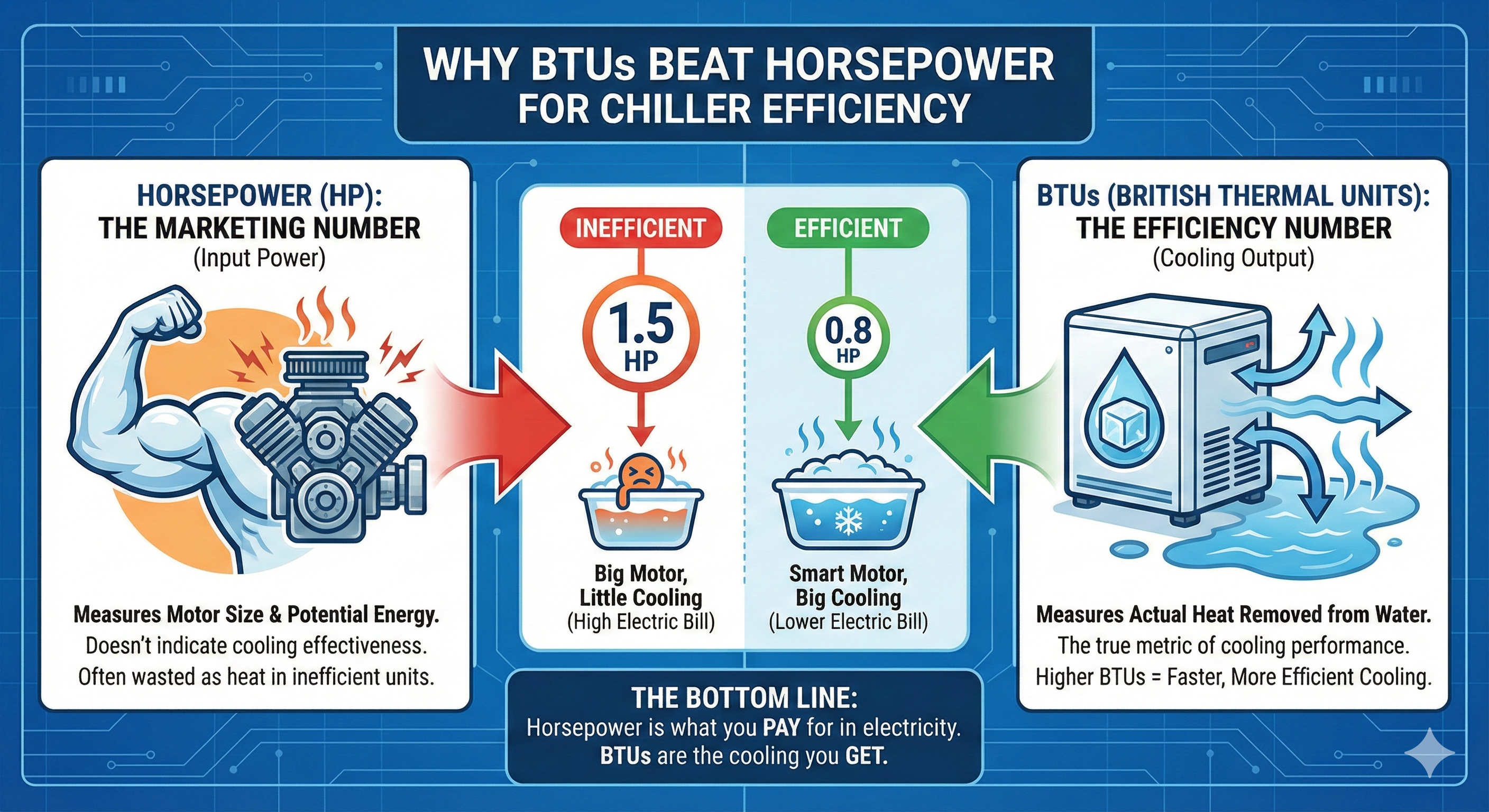
Chillers are usually listed by horsepower, such as 1 HP or 1.5 HP. Horsepower tells you the size of the motor. The BTU rating tells you how much heat the chiller pulls out of the water. It is a useful number to have alongside the horsepower.
Just as important, and often overlooked, is derating: how a unit's cooling power falls off in tough conditions. A chiller that performs well in a cool showroom can lose a lot of its cooling power in a hot spot. Think of a garage above 95°F. Then it runs harder, can trip a breaker, or never reaches the water temperature you set. Ask how a model performs at the temperatures where it will live.
Ask for the BTU rating (British Thermal Units) along with the horsepower. The BTU rating tells you how much heat a system can remove per hour, which gives a clearer picture of performance in different conditions. With BTU ratings and documented performance at the temperatures you expect, you can compare models side by side. Then choose a cold plunge that holds your set temperature.

Water care: clean water takes a 3-step system
Good water care uses more than one method. Cold water does not kill germs. Without regular cleaning, germs can grow in the slimy film, called biofilm, that builds up on tub walls. CDC's guidance for hot tubs calls for a chlorine or bromine disinfectant in the water at the right level. It also calls for scrubbing all surfaces when the tub is drained, because biofilm and sediment feed Legionella bacteria (CDC). UV and ozone work on the water as it passes through the pipes. They do not clean the tub walls.
To keep the water in your cold plunge clean, use a three-part system. Some call it the "Triad of Clean": filtration, UV or ozone, and a sanitizer. Filtration should start with a net or cartridge that catches hair and skin particles; aim for a filter rated between 20 and 50 microns. Filters that are too fine clog quickly, while those that are too coarse miss smaller debris.
The second part, sometimes called "The Sniper," uses UV or ozone on the water flowing through the pipes. The third, "The Security Guard," is a sanitizer that reaches the water touching the tub walls and corners, where light cannot reach. CDC's hot tub guidance calls for chlorine or bromine (CDC). Your plunge maker's care guide tells you which sanitizer and level your tub is built for. One method on its own is not enough. Follow your plunge maker's care guide, change the water on schedule, and scrub the tub when you drain it.

Insulation: what R-value tells you
Cold plunges come in a variety of materials, and each holds the cold differently. Inflatable "drop-stitch" tubs are light and portable, and the air in their walls does the insulating. Foam-filled walls hold the cold longer. In warm weather, a tub with thinner walls gains heat faster, so the chiller runs more to hold your set temperature.
Think of R-Value as a "Thermal Shield Score." The "R" stands for Resistance: how well the material resists letting heat pass through it.
- Low R-Value (R-1): Like wearing a thin cotton t-shirt in a blizzard. The cold escapes right away (or in this case, the heat rushes in).
- High R-Value (R-20): Like wearing a thick down parka. It makes a strong barrier that locks the temperature in.
Why it matters to you: In a cold plunge, the room is always trying to warm your water up to its own temperature. A tub with a high R-Value stops that heat at the door. A tub with a low R-Value lets the heat walk right in, so your chiller (and your electricity bill) works overtime to keep up.
Tier 1, the best option, is rotomolded plastic filled with pressure-injected foam, with an R-Value of 10 to 20 or more. It behaves like a high-end hard-sided cooler, holding its temperature for a long time. Tier 2 is the inflatable drop-stitch tub, which uses an air gap and reaches an R-Value of about 2 to 3. These tubs are portable but hold the cold less well. Tier 3 is the single-wall plastic or steel tub, with no insulation and an R-Value close to 0. Expect condensation, and a chiller that runs around the clock to keep the water cold.
A simple way to judge a tub is the "knock" test. Rap your knuckles against the side. A hollow sound means the tub is air-filled or thin plastic. A solid "thud" suggests a foam-filled wall that holds its temperature much better. It is a quick check that helps you make a smart choice with your cold plunge investment.
If you go inflatable, plan for a chiller or regular ice runs.

Electrical safety comes first
What does a safe electrical setup look like?
Many cold plunges plug into a home outlet, and setting one up safely takes a few simple checks. Water and electricity are a dangerous mix. If you build your own plunge with a chiller, pump or freezer, plug each part into a GFCI outlet. Have a licensed electrician do any wiring.
One common safety question is extension cords. Chillers draw a surge of current when they start, so follow your chiller maker's rules on extension cords exactly. If the manual says not to use one, don't. Plug the chiller into a GFCI-protected outlet (CPSC). Use a dedicated outlet with wiring rated for the load, as your local electrical code requires.
A GFCI (Ground Fault Circuit Interrupter) is not a normal bedroom outlet. It is the outlet you usually see in bathrooms, kitchens and garages, and it is a key safety part of any cold plunge setup.
How to identify it: Look at the outlet on your wall. Does it have two small buttons in the middle, usually labeled "TEST" and "RESET"?
- Yes: That is a GFCI.
- No: That is a standard outlet and not acceptable for a cold plunge without changes.
What it does: A normal breaker protects the house from overloads. A GFCI is built to protect you. It constantly compares the electricity going out with what comes back. The Consumer Product Safety Commission says a GFCI, or ground fault circuit interrupter, cuts power faster than the blink of an eye. It acts when it detects leaking current, which can protect you from a severe shock. Test your GFCI at least once a month.
Correct circuit capacity and a dedicated outlet matter for any cold plunge system. Plug the chiller only into a GFCI-protected outlet, and follow the maker's rules on extension cords. If your outlet doesn't have the "Test/Reset" buttons, call a licensed electrician to install a dedicated, properly grounded GFCI outlet before you fill your tub.
Certifications and intended use: look for a UL 1563 or ETL sticker on the chiller itself. These marks show the product has been tested to accepted safety standards. If the user manual says "For Aquarium Use Only," the product is not meant for people to sit in. Do not get in the water. Check the certification and the setup before you invest in any cold plunge system.

Fit: check the depth
Tub depth decides how much of you the water covers. Some tubs are about 24 inches deep, which can leave a taller person's knees or chest out of the water. A deeper tub lets you sit with the water up to your shoulders, which many people prefer.
To check whether a tub will fit you, try a simple fit test. Sit on the floor with your back flat against a wall and measure from the floor to your collarbone. If the tub's internal depth is less than that, you will not be able to sit shoulder-deep. For most adults, look for a minimum internal depth of 28 to 30 inches. A deeper tub does not need a bigger footprint, so it can still suit small spaces.

A quick checklist for choosing the best cold plunge
Before you buy, check these in the product listing, or ask us.
[ ] Cooling power: the BTU rating as well as the horsepower.
[ ] Water care: the sanitizer and level the maker recommends, alongside any UV or ozone system. CDC's hot tub guidance calls for a disinfectant to control germs that grow in biofilm (CDC).
[ ] Materials and depth: the wall material, such as reinforced PVC or rotomolded foam, and an internal depth that fits you.
Final verdict: when you invest in a premium cold plunge system, look first at the chiller and the safety features. Then check that the tub fits your size and needs. After that, pick the look and features you will enjoy every day.
You can compare our cold plunges against this list. Not sure one will fit your space? Ask us before you order.