The 5 Lies Cold Plunge Brands Are Telling You-2026 Buyer's Guide to Find the Best Cold Plunges
Introduction: The "White Label" Epidemic — Choose the Right Cold Plunge
The cold plunge market is currently inundated with a vast array of products. A significant portion of what consumers encounter online consists of "white label" items—generic machines produced in large quantities overseas and sometimes dressed up as the next best cold plunge tub or premium cold plunge. These offerings range from basic inflatable tub and inflatable cold plunge options to more polished-looking units like a sun home cold plunge or a supposed plunge pro, but many prioritize branding over engineering. Even chiller-equipped units can vary wildly in quality: a high price point doesn't always equal the best cold plunges or the best cold plunge overall. If you're buying a cold plunge tub for your home gym or searching for the best portable cold plunge, it's important to recognize that cold plunge tubs come in many forms—vertical cold plunge models, cold pod designs, cold tub setups, and even DIY cold plunge builds—and not all deliver reliable cold water immersion or keep the water colder for longer. Understanding the difference between true cold water therapy equipment and white-label hype helps ensure your investment supports real cold therapy, the benefits of cold water immersion, and consistent cold temperatures during cold plunge sessions.
In today's market, sheer aesthetics and marketing tactics often overshadow essential functionality. Whether you're tempted by a luxury cold plunge like the sun home cold plunge pro, a budget model such as the best budget cold plunge or inflatable plunge tub, or a specialty unit like the supertub cold plunge and redwood outdoors alaskan cold plunge, focus on the physics behind cold exposure and how units are tub made, cooled, and insulated. This buying a cold plunge guide helps you cut through jargon—compare chillers, cooling capacity, pump reliability, and how easy the unit is to maintain or retrofit for hot and cold use. If you want a tub that delivers the true benefits of cold, from enhanced recovery to improved circulation, choose the right cold plunge tub by prioritizing tested performance over promises. That way your cold plunge experience, whether a quick cold water therapy dip or extended cold water immersion practice, will be effective, safe, and durable—giving you the best value and the best cold plunge experience for your needs.
This buying guide for cold plunges 2026 does not endorse specific brands or recommend the best cold plunge tub overall; instead it teaches you how to evaluate the components, construction, safety features, and performance metrics of a quality cold plunge so you avoid wasting money or risking your safety.
Lie #1 When Buying a Cold Plunge Tub: Cold Plunge Seller's claim they have the best cold plunge tub because "More Horsepower Means It Cools Faster"— BTUs, not raw HP, determine the chiller's cooling power and efficiency
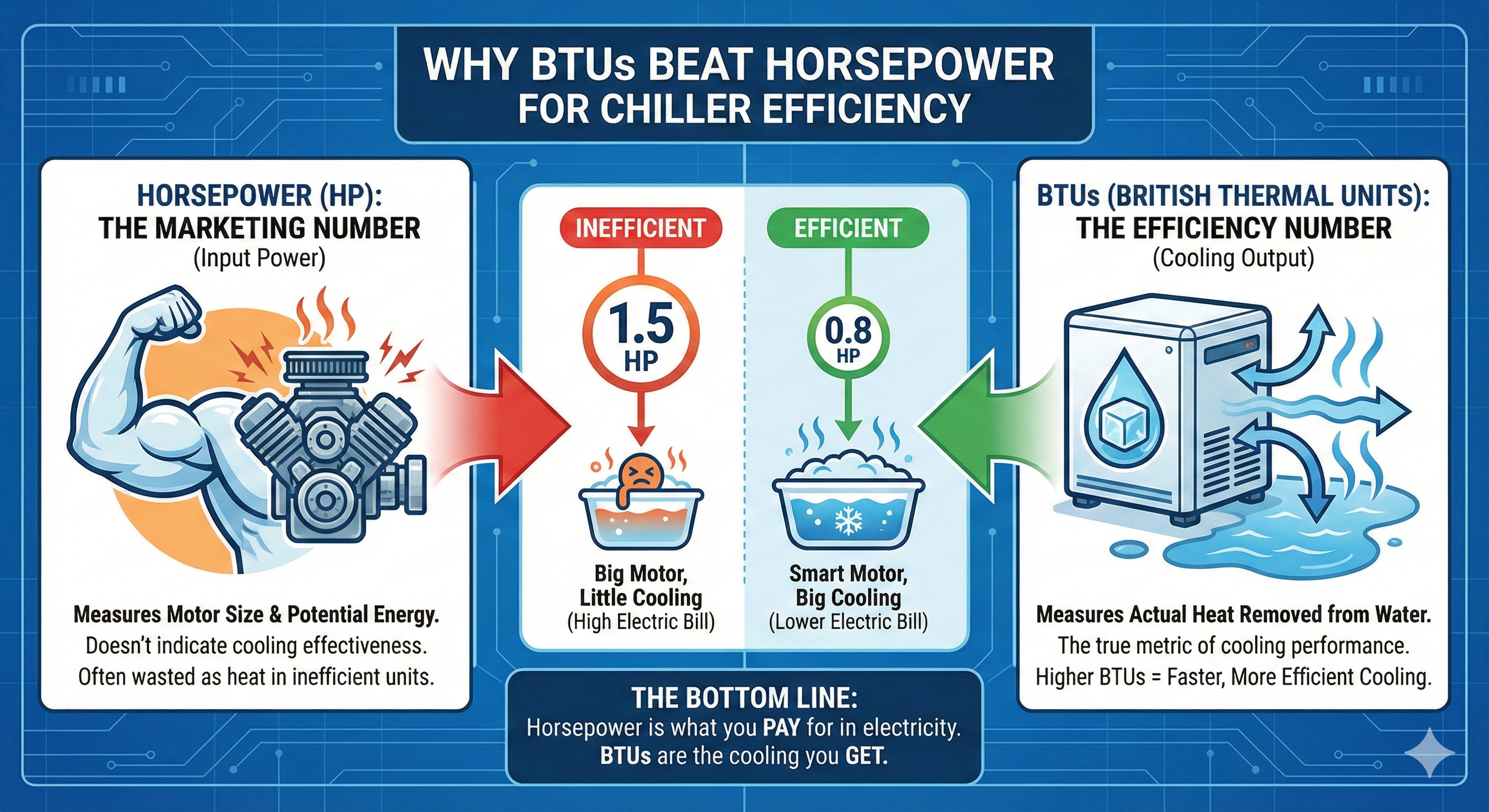
The marketing hype surrounding cold plunge units often leads consumers to equate higher horsepower with better cooling and overall performance. Brands commonly advertise flashy figures like "1HP" or "1.5HP," implying superior power, but horsepower mainly denotes motor size, not system efficiency. A low-quality 1 HP motor can waste up to 40% of its input energy as heat, driving up electricity costs while struggling to move heat out of the water. In practical terms, choosing solely by advertised horsepower is like picking a car based on engine noise instead of real-world speed, efficiency, or cooling performance.
Equally important — and often overlooked — is derating: how a unit’s cooling power falls off under adverse conditions. A chiller that performs well in a cool, climate-controlled showroom can suffer significant derating in a hot environment (for example, a garage above 95°F), reducing efficiency and available power. That can cause the unit to run harder, trip safety breakers, or simply fail to reach the desired water temperature. Buyers should evaluate how a model maintains performance under realistic ambient temperatures, not just idealized specs.
Rather than relying on horsepower labels, request the BTU rating (British Thermal Units) to understand true cooling power and real-world efficiency. The BTU rating quantifies how much heat a system can remove per hour, giving a clearer picture of performance across different conditions. By prioritizing BTU ratings and documented efficiency at expected ambient temperatures, consumers can compare models objectively and choose a cold plunge that reliably meets their cooling needs without hidden energy penalties.

Lie #2 When Buying a Cold Plunge Tub: Cold Plunge Seller's claim "Chemical-Free Means It's Safe" when advertising they have the best cold plunge overall — The Best Cold Plunge Tub Overall Uses 3 a 3-Step System for Clean Water
Many brands in the cold plunge market—whether promoting a plunge tub, an inflatable cold plunge, a vertical cold plunge, or a high-quality premium cold plunge—position their products as "premium" by claiming their UV or Ozone systems make the water "100% safe" without the need for chemicals. This marketing message, found in cold plunge review copy and cold plunge tubs of 2025 roundups, could lead consumers to believe these systems provide a complete solution for water sanitation. However, the reality is that cold water and exposure to cold water do not eliminate bacteria; rather, cold water can preserve microbes in a dormant state. Unless there is active cleaning in place, a cold plunge can quickly transform into a "stagnant bioreactor," essentially a breeding ground for pathogens that can become active upon contact with warm skin. UV and Ozone treatments only target bacteria that pass directly through the light in the pipes and do nothing to address the biofilm that accumulates on walls of a tub—whether it's a cold life plunge, a sun home cold plunge, or a DIY cold plunge setup.
To ensure the water in a cold plunge remains safe for use—whether you're buying a cold plunge for small spaces, considering the best cold plunge tub overall, or checking cold plunge tub offers—implement a comprehensive three-part cleaning system. This "Triad of Clean" is recommended across cold therapy practice guides and cold plunge reviews: filtration, UV or Ozone treatment, and a low-dose sanitizer. Filtration should start with a net or cartridge that catches hair and skin particles; aim for a filter rated between 20 and 50 microns. Filters that are too small clog quickly, while those too large fail to capture smaller debris in your cold water therapy tub, inflatable tub, or cold tub used for cold water immersion sessions.
The second component, sometimes called "The Sniper," uses UV or Ozone to reduce bacteria flowing through pipes—an important part of many cold plunge tubs and cold and hot plunge tub systems like inergize cold and hot plunge units. The third, "The Security Guard," uses a low-dose sanitizer (for example, a chlorine-free oxidizer) to target bacteria that adhere to surfaces or hide in corners where light cannot penetrate. If a company markets a "100% Chemical Free" solution that requires no maintenance—whether selling the best inflatable cold plunge, the best luxury cold plunge, or a budget cold pod—take that claim with caution. Relying on a single method of sanitation is insufficient for a safe cold plunge experience, whether you want a vertical cold plunge, the best cold plunge for small spaces, or a favorite plunge all-in system like a plunge pro or hydragun supertub cold plunge. Proper care keeps the water cold for longer and ensures your cold water immersion and cold therapy sessions provide the benefits of cold water exposure without unnecessary risk.

Lie #3 When Buying a Cold Plunge Tub: Some Cold Plunge Seller's Claim "Inflatable Cold Plunges Are the Best Value and a Cost-Effective Replacement for Premium Cold Plunges" — The Best Cold Plunge Tub Overall has a High R-Value
Cold Plunges come in a variety of materials. Inflatable "drop-stitch" tubs are often marketed as being "fully insulated" and equally effective as traditional permanent tubs. This marketing claim can be enticing, especially for those seeking a portable and convenient option. However, the truth is that the primary insulator in an inflatable tub is merely air. While air does provide some insulation, it pales in comparison to the effectiveness of foam insulation. In warmer conditions, heat readily permeates through the thin plastic walls of inflatable tubs, forcing the chiller to work continuously to maintain the desired water temperature. As a result, these inflatable options can be significantly less efficient than their rigid counterparts.
To better understand the quality of insulation, it is helpful to categorize different tub materials based on their effectiveness.
Think of R-Value as a "Thermal Shield Score." The "R" stands for Resistance—specifically, how well the material resists letting heat pass through it.
- Low R-Value (R-1): Like wearing a thin cotton t-shirt in a blizzard. The cold escapes instantly (or in this case, the heat rushes in).
- High R-Value (R-20): Like wearing a thick, down parka. It creates a powerful barrier that locks the temperature in.
Why it matters for your wallet: In a cold plunge, nature is constantly trying to heat your water up to room temperature. A tub with a high R-Value acts like a heavy-duty bouncer, stopping that heat at the door. A tub with a low R-Value lets the heat walk right in, forcing your chiller (and your electricity bill) to work overtime just to keep up.
Tier 1, which represents the best option, consists of rotomolded plastic filled with pressure-injected foam, achieving an R-Value of 10-20 or more. This type of construction behaves similarly to a high-end Yeti cooler, holding its temperature for extended periods. Tier 2 includes inflatable drop-stitch tubs, which utilize an air gap and achieve an R-Value of approximately 2-3. While these tubs are portable, they are less efficient in retaining heat. Finally, Tier 3 consists of single-wall plastic or steel tubs, which offer no insulation and have an R-Value close to 0, leading to condensation and requiring the chiller to run around the clock to keep the water cold.
A simple yet effective way to assess the quality of a tub is to perform the "knock" test. By rapping your knuckles against the side of the tub, you can gauge its construction quality. If you hear a hollow sound, it indicates that the tub is either air-filled or made from thin plastic. Conversely, a solid "thud" sound suggests that the tub is foam-filled and thus much more efficient in retaining temperature. This straightforward test can be a valuable tool for consumers seeking to make a smart choice regarding their cold plunge investment.
When comparing options, keep in mind related choices and features people often search for—whether you’re looking at a hot tub or the best hot and cold plunge combo, checking cold plunge tub offers, or evaluating a top cold plunge model. Many buyers want their cold plunge to stay cold during warm weather, and they try to find the best cold plunge that will fit their space; plunge tubs come in various sizes and the best cold plunge tub shape matters for placement. If you’re new to cold therapy without prior experience, read about the effects of cold water immersion and how using a cold plunge influences recovery. Some shoppers prefer a high-quality cold plunge or a best customizable cold plunge, while others choose proven names. Whether you want an outdoors cold plunge tub or the best vertical cold plunge for a compact footprint, prioritize models that provide the best insulation so you don’t end up with a plunge that is an inflatable unit that can’t stay cold. If your plunge is inflatable, you'll be buying a lot of ice. f you’re deciding between hot or cold options, like the best hot and cold combos, it’s best to check reviews from those who tested the best cold plunge, chose the best cold setups, and named a favorite cold plunge. Also consider accessories—from adding a cold cover to using the best massage guns post-plunge—to help you enjoy cold therapy and find the best cold plunge solution for your needs.

Lie #4 When Buying a Cold Plunge Tub: Cold Plunge Seller's claim they have the best cold plunge tub because "You Can Plug This In Anywhere" — The Best Cold Plunge Tubs Prioritize Electrical Safety
Buying Guide for Cold Plunges 2026 — Safety & Electrical Considerations
Brands often promote their cold plunge products as being as simple to operate as a toaster—just plug it in, and you're good to go! In this buying guide for cold plunges 2026, it's important to understand that this oversimplification can be misleading. Combining high-voltage electricity with water necessitates strict adherence to safety protocols during installation and ongoing use. Consumers must recognize that improper setup can lead to dangerous situations, including the risk of electric shock, chiller failure, or fire hazards.
One significant safety concern is the use of extension cords. It is imperative to never use an extension cord with a chiller because these devices require a high in-rush current to start. When an extension cord is used, it increases resistance, which can lead to overheating and melting of the plug, creating a potential fire hazard. This risk underscores the importance of ensuring that the cold plunge is connected directly to a dedicated outlet and properly rated wiring per electrical codes.
Additionally, it is essential to use a dedicated outlet equipped with a Class A GFCI (Ground Fault Circuit Interrupter). A GFCI is not a normal bedroom outlet. It is the specific outlet you usually see in bathrooms, kitchens, and garages, and it’s a critical safety component for any cold plunge installation.
How to Identify It: Look at the outlet on your wall. Does it have two small buttons in the middle, usually labeled "TEST" and "RESET"?
- Yes: That is a GFCI.
- No: That is a standard outlet and not acceptable for a cold plunge without modification.
What It Does (The 0.025 Second Lifesaver): A normal breaker protects the house from burning down. A GFCI protects you from electrocution. It constantly watches the electricity going out and coming back. If it sees even a tiny amount "leaking" (as little as 4 to 6 milliamps), it cuts the power in 1/40th of a second.
Proper installation, including ensuring correct circuit capacity, dedicated outlet wiring, and adherence to these safety measures, is critical for the safe operation of any cold plunge system. Never plug a cold plunge into a standard outlet or a normal extension cord. If your outlet doesn't have the 'Test/Reset' buttons, you must call a licensed electrician to install a dedicated, properly grounded Class A GFCI outlet before filling your tub.
Certifications and Intended Use: To further ensure safety when shopping in 2026, consumers should look for a UL 1563 or ETL sticker on the chiller itself. These safety certifications indicate that the product has been tested and meets accepted standards. If the user manual specifies "For Aquarium Use Only," it is a clear sign that the product is not intended for human immersion, and you should not enter the water under any circumstances. Prioritizing safety, correct electrical installation, and verified certifications is paramount when investing in a cold plunge system.

Lie #5 When Buying a Cold Plunge Tub: Cold Plunge Seller's claim they have the best cold plunge tub because its "Military Grade" — The"One Size Fits All" Myth (This is Still Applicable Even When Looking for the Best Cold Plunge for Small Spaces)
Many brands market their tubs as "Military Grade," claiming that they are designed to accommodate everyone. This terminology is often employed to evoke a sense of toughness and durability; however, the reality is that "Military Grade" is largely unregulated marketing jargon. Most inexpensive tubs on the market are only 24 inches deep, which presents a significant issue for taller individuals. For taller individuals, a shallow tub forces the knees or chest to protrude from the water, breaking the thermal seal around the neck. This prevents the cold water from stimulating the Vagus nerve in the upper chest and neck, effectively blocking the full activation of the Mammalian Dive Reflex and reducing the anxiety-calming benefits of the plunge. Therefore, you want a cold plunge that allows you to fully submerge your upper chest and neck.
To determine if a tub is suitable for your needs, a simple fit test can be conducted. Sit on the floor with your back flat against a wall and measure the distance from the floor to your collarbone. If the internal depth of the tub is less than this measurement, it will not allow for full submersion, which is essential for achieving the desired physiological benefits. If you're worried if your cold plunge will fit, there is not a significant space difference beTherefore, it is highly recommended to look for a tub with a minimum internal depth of 28 to 30 inches, ensuring that individuals can fully immerse themselves for an optimal experience.

The "Red Flag" Checklist to Consider When Evaluating the Best Cold Plunges
If you come across any of the following phrases in marketing materials, it is essential to approach them with a high degree of caution. These red flags may suggest that the product does not adhere to the necessary standards or that the company is employing deceptive marketing tactics designed to mislead consumers into making uninformed decisions.
[ ] "1HP" with no BTUs listed: This could indicate that the manufacturer is hiding a weak compressor that may not perform as expected.
[ ] "Chemical Free": This is a potentially dangerous marketing claim that overlooks the significant risks associated with biofilm buildup, which can pose health hazards.
[ ] "Military Grade": This term is often just meaningless fluff that does not provide any real information about the product's quality. Instead, focus on more informative descriptors like "Reinforced PVC" or "Rotomolded" materials, which are indicative of durability.
Final Verdict: When buying a cold plunge or investing in a premium cold plunge system, it is crucial to prioritize the quality of the engine, verify that appropriate safety measures are in place, and ensure that the product is suitable for your specific size and needs. The other factors, like aesthetics and different marketing claims, should be viewed as less significant compared to these essential factors that directly influence your experience and safety.